Don't force me to follow your philosophy
A few months ago I switched over from Apple watch to a Garmin one because I found myself losing all my sleep data when I forgot to take it off the charger before bed. It seems insane to me that Apple cannot squeeze more than a day out of their device whilst Garmin devices, with more features can last over a week. Since switching I have a more complete dataset than ever about my sleep data.
A kicker to this is getting used to a new suite of software and tooling to analyse the data. Enter Garmin Connect which seems to be a very comprehensive set of tools to look at various metrics and track progress.
Side note: The metric I needed most which actually seems somewhat unnecessarily convoluted in the Garmin ecosystem is something called Training Stress Score or TSS. I do not have a very good grasp on when my body needs to rest and about a year and a half ago, found myself with various injuries which I now recognise as over training related. I probably don’t need this metric to know doing back to back to back intense Zwift races is a recipe for disaster. But this is not the focus of this blog.
Garmin Connect also has social aspects of its UX. You can essentially follow a feed of people you know and what activities they get up to. This is great motivation to see folks getting out doing a swim, run, bike or just a simple walk and helps build a healthy relationship that exercising and taking care of your body is a normal everyday thing in a world where inactivity and obesity is common.
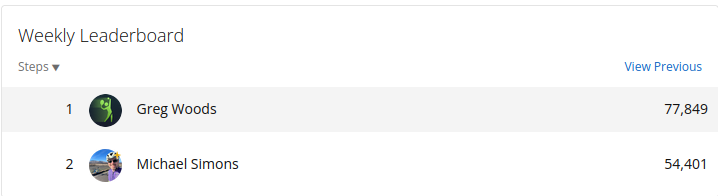
There is one feature that grinds me a little bit, the weekly leader board. Users weekly stats for steps, biked miles, etc are added up and put up in a littler leader board.
The philosophy behind it is clear, competition is good and can motivate you to improve yourself. I am also a believer of this philosophy. Although I have not played sport to what any sane person could describe as professional I have played many competitive matches of football, cricket and rugby. At these times I have chosen to enter the competitive space, place my skills and the skills of my team mates against those of the opposition and tried to come out on top. I have learnt many valuable things from these experiences.
But the key part of this is that I chose to enter these competitions. I wasn’t forced onto the wicket with a bat to stare down the other end of the wicket for someone to throw a ball at me as fast as they can. This is something I chose to do.
However the Garmin leader board is not something I chose to compete in and if I did want to compete with anybody at anything, it wouldn’t be how many times I have planted one foot in front of the other. Daily movement in general has been a key part of my recovery from a health issue and what motivates me to do these steps is my health and not can I beat so and so at it. What is important is that I am doing it not how much I am doing it. We all have different motivations and goals and that our software should support us in tracking and achieving those goals.
Then what is the problem? The problem is that there is no opt out configuration. There is no little “x” to close the leader board. The writers and designers of this software have subscribed to the philosophy of “competing at everything is good” and at the same time the viewpoint of “what we think is good is good and there is no other way”. This is a deeply troubling position.
(There may be a way to disable this but it is non-trivial, at least for me. Besides this still is troubling that it is by default opt-in.)
Subconsciousness creeps in however. We’ve all been in some situation where when we’ve thought something through actively and decided its not for us but then due to convenience, habit or temptation we get sucked in, maybe not even realising that we’ve been sucked in until then next time you place some active thought onto it. And so I started competing.
As someone who writes software to be consumed by other this has made me reflect on how design decisions can have deep consequences. We often want to make things as easy as possible for users which typically means making some assumptions about what they are doing so that we can make what we believe are reasonable default values. We should do our best to be aware of our own biases, not least because we are not at all representative of the user base in general. But the user must always have some way to change them.
I’m typing this blog out in Typora where it is clear that the authors are deeply compassionate people. I can tell this not just because the UX is intuitive and clean but because everything is configurable to your preferences and taste. For example, being an US company they have set the default language to US English which, as a British person, brings the red hot rage of seething but under the surface contempt that is unique to my culture. But the authors do not force me to stew in my anger because of a wonderful preferences menu.
Then common Garmin remove your bias and make some more compassionate design decisions. A great way to do this would be during sign-up asking users what motivates them and choosing defaults that way. But for crying out loud at least give users a choice and don’t force them to follow your philosophy.
Shout out to Garmin Grafana. One way to avoid the author philosophy is to take ownership of your own data and this tool does just this, taking regular sync and storing it locally. You can then craft whatever philosophy you want into the Grafana UI. Maybe your philosophy is to do the least amount of steps ¯\(ツ)/¯.
Either way, nah na nah na nah, I beat you Micheal Simons…